
Four Futures: A Framework for Optionality
The Power of Networks

In 1998, I sat in a room at Boeing Phantom Works with a team tasked to answer a simple question: What will the world look like in 2025, and what systems should the defense industry build to protect Western interests?
We didn’t try to predict the future. Prediction is a fool’s game when the variables are geopolitical. Instead, we built scenarios. Alternative futures with internal logic, stress-tested through wargames with National Command Authority. Real option analysis applied to national strategy. We used this to determine the break point in a Nash equilibrium. The approach derived from Shell’s futures work under Pierre Wack, adapted for defense planning.
The weapon systems you see deployed today emerged from that process. Not because we guessed right about which future would arrive, but because we built capability that worked across multiple futures.
Dan Case, who ran Hambrecht & Quist during the same period, understood the same principle applied to investing. H&Q sat in the middle of the startup stew when other banks fled Silicon Valley after the S&L crisis. They saw deal flow before anyone else. They had lunch with the founders building the future. The value wasn’t in predicting winners. It was in seeing the present more clearly than everyone else, then positioning for optionality.
The acceleration of AI and the differing levels of network understanding among some states, but not others, disrupt traditional frameworks. It is a predictable turn of events in the 4th turning. The world is shifting, and the question isn’t which future arrives. The question is who maintains optionality across all of them.
The Four Scenarios
In 1998, we framed four alternative futures:
US rules supreme; all other countries are weaker
US and China rule supreme and are nearing conflict
The US fragments into regional spheres with no global superpower
Corporations with strong brands control global influence; governments are subordinate
We have a little of all four in play today. That was the point. Scenarios aren’t predictions. They’re stress tests for strategy.
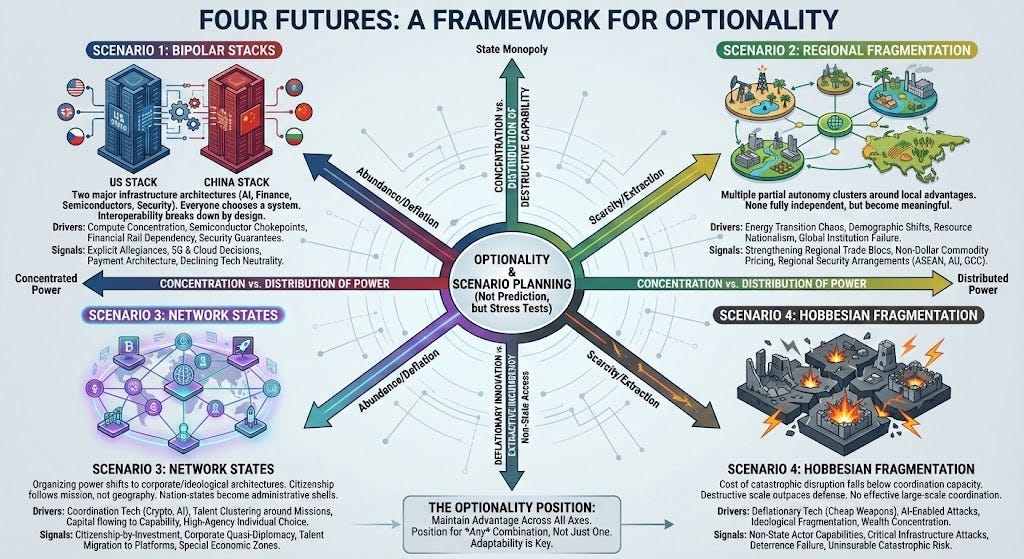
The current environment suggests a revised framework. Four futures that capture the range of where power might consolidate and how coordination might evolve. And while I don’t have 100 analysts spending months in a SCIF working on wargames with the Pentagon and the White House, let me offer a best-guess framework.
Scenario 1: Bipolar Stacks
The world consolidates into two infrastructure architectures. US and China. Everyone else chooses which system to run on.
This isn’t Cold War ideological poles. It’s infrastructure dependency. The AI stack, financial rails, semiconductor supply chains, intelligence systems, security guarantees. Each stack is a complete operating environment. Running both becomes increasingly difficult as the stacks diverge on standards, protocols, and trust architectures.
The drivers pushing toward this future: AI compute concentration in a handful of fabs. Semiconductor chokepoints that give the US leverage over anyone dependent on advanced chips. Financial rail dependency that makes dollar exclusion catastrophic. Security guarantees that require alignment to access.
The signals that would tell us we’re moving this direction: Middle powers explicitly choosing infrastructure allegiances. 5G decisions. Cloud provider selection. Payment system architecture. Crypto. Declining neutrality in tech standards bodies. Cross-stack interoperability breaking down not by accident but by design.
Who wins: The US and China as platform owners. Countries that pick early and integrate deeply enough to matter to their patron.
Who loses: Fence-sitters who try to maintain optionality without the resources to back it. Countries that attempt to run both stacks and end up with the disadvantages of each. Europe if it can’t decide.
Scenario 2: Regional Fragmentation
Multiple clusters develop partial autonomy around local advantages. None achieves full independence from the major stacks, but several become meaningful enough to matter.
The Middle East leveraging energy transition chaos to maintain relevance. Africa leveraging demographics as the only continent with population growth (note to Elon). Southeast Asia as a manufacturing alternative to China. Latin America with agricultural capacity and resources. Each cluster has leverage but lacks the full stack to operate independently.
The drivers: Energy transition creating new chokepoints and stranding old ones. Demographic collapse in developed economies creating labor dependency on growing populations. Resource nationalism as countries realize commodity exports don’t translate to power without conversion capacity. The failure of global institutions creating demand for regional alternatives.
The signals: Regional trade blocs strengthening faster than global ones. Commodity pricing in non-dollar currencies gaining traction. Regional security arrangements outside the US-China umbrella. ASEAN, African Union, Gulf Cooperation Council gaining operational capacity rather than just holding summits.
Who wins: Countries with convertible leverage. Resources plus the capability to process them. Regional hegemons who can coordinate their neighbors. Saudi Arabia, Nigeria, Indonesia, Brazil. Who loses: Small countries without a regional anchor. Countries with resources but no conversion capacity. Anyone dependent on global institutions that no longer function.
Scenario 3: Network States (My personal Favorite)
Organizing power shifts from geography to network affiliation. Corporate and ideological architectures become primary. Nation-states become administrative shells.
Balaji Srinivasan articulated this most clearly in The Network State. The progression runs: online community to network union to network archipelago to network state. Shared mission, economic activity, physical nodes, and eventually diplomatic recognition. Citizenship follows from what you’re building, not where you were born. Vibe coding at the next level. Or a moment of fulling embracinging natural rights.
The drivers: Coordination technology enabling non-territorial organization. Crypto, AI, global communications. Talent clustering around missions rather than flags. Capital flowing to capability vectors. Mars, longevity, energy, AI infrastructure. High-agency individuals gaining the ability to choose affiliations rather than accept inherited ones.
The signals: Citizenship-by-investment expanding and becoming normalized. Corporate entities gaining quasi-diplomatic status. Talent migration following companies rather than countries. Balaji-style experiments achieving critical mass. Dubai, Singapore, and special economic zones becoming more attractive than legacy jurisdictions.
Who wins: Platform builders. Musk, Altman, whoever architects the stack that talent and capital flow through. High-agency individuals who can choose affiliations. Mission-driven clusters with real capability. Who loses: Geographically-stuck populations without mobility. Nation-states that can’t compete with network offerings on services, taxes, or opportunity. Anyone dependent on territorial institutions.
The critical question for this scenario: Does it inherit the constitutional structure that makes natural rights operational? The tech-sovereign crowd thrives within the US system because of enumerated powers, dispersion, and legal architecture that lets weirdos accumulate capital and take existential bets. System C without a constitutional foundation is just a new king with better tools.
Scenario 4: Hobbesian Fragmentation
The cost of catastrophic disruption falls below the coordination capacity of any organizing structure.
In 1997, building a nuclear weapon required a nation-state. Industrial base, scientific establishment, security apparatus to protect the program. By 2025, the barrier has dropped. A sufficiently resourced billionaire could do it. By 2035, the barrier drops further. Bioweapons. Autonomous drone swarms. AI-enabled attacks on critical infrastructure.
This scenario isn’t about who organizes power. It’s about what happens when the ability to destroy scales faster than the ability to coordinate defense.
The drivers: Deflationary technology cutting both ways. The same forces that make solar panels cheap make weapons cheap. AI acceleration of attack capabilities outpacing defensive adaptation. Ideological fragmentation creating motivated actors. Wealth concentration putting catastrophic capability within reach of individuals.
The signals: Non-state actors demonstrating capabilities previously reserved for nations. Critical infrastructure attacks succeeding. Deterrence frameworks failing because attribution becomes impossible or actors can’t be deterred. Insurance markets pricing catastrophic risk as uninsurable.
Who wins: Nobody, really. Perhaps hardened enclaves with local resilience. Perhaps whoever builds the surveillance architecture can prevent attacks before they happen. Who loses: Anyone dependent on large-scale coordination. Cities. Global supply chains. Complex systems that require trust to function.
This scenario drives Scenarios 1-3 to converge on surveillance and control. China’s social credit. US intelligence architecture. Tech platforms as monitoring infrastructure. The freedom-security tradeoff sharpens: How much liberty do you sacrifice to prevent any single actor from burning it all down?
The Three Axes
These scenarios aren’t discrete futures. They’re positions along three axes that interact.
Axis 1: Concentration versus distribution of legitimate power. Do a few large players coordinate the system, or does power disperse to networks, regions, and non-state actors?
Axis 2: Concentration versus distribution of destructive capability. Do nation-states maintain monopoly on catastrophic force, or do non-state actors gain access?
Axis 3: Deflationary innovation versus extractive incumbency. Does technology drive costs toward zero and create abundance, or do incumbents capture regulatory structures and maintain artificial scarcity?
The third axis is the one most people miss. Deflationary innovation changes the math on everything else. In our scenarios from the late 90s, we saw deflation as a bit of a stalemate, like in wargames, when Joshua concludes, “The Only Winning Move Is Not To Play.” Innovation is deflationary leads to a Nash equilibrium.
When goods and services cost less, the tax base changes. Governments built on extracting value from transactions have less to extract. Either they find new sources of legitimacy, or they become irrelevant administrative shells. System B’s extractive model depends on friction. Remove friction, remove the revenue model.
Deflation also cuts both ways on destructive capability. The same AI that accelerates drug discovery accelerates bioweapon design. The same drones that deliver packages can deliver explosives. Deflationary innovation doesn’t have a moral valence. It’s a multiplier on whatever humans decide to do.
The Optionality Position
The US doesn’t need to know which scenario emerges. It needs to maintain an advantage across all three axes so that whichever future materializes, it’s positioned.
Decades of network-centric iteration gives the US operational muscle memory that other powers can’t replicate by buying the same equipment. You don’t catch up on 100 iterations by reading the manual. The learning is embedded in doctrine, personnel, institutional knowledge, and feedback loops between operators and developers.
The same architecture that gives destructive dominance also gives innovation dominance. C4ISR infrastructure, financial rails, corporate reach, research universities, venture capital, and immigration of high-talent individuals. These aren’t separate advantages. They’re the same network operating in different domains.
Plus, natural resources as a hedge. Energy independence. Agricultural surplus. Water. Arable land. If globalization fragments, the US can feed and power itself. Most other players can’t.
But China has to bet. One-party control means they optimize for concentrated power, concentrated violence, extractive economics. They’re building for Scenarios 1 or 4. If the world goes distributed or deflationary, their architecture fights them. But they think in longer time horizons than electoral cycles allow. That’s their edge. Though it could be their curse if they convince themselves they are right.
Europe bet on rules-based order and lost. No Plan B. The EU proved that middle-power coordination doesn’t scale.
Network states offer a different kind of optionality. Migration in situ. You don’t have to physically move to change your primary affiliation. Citizenship becomes a subscription rather than an inheritance. For high-agency individuals, this is freedom. For nation-states dependent on captive tax bases, it’s an existential threat.
If natural rights are actually the first principle system C endpoint and network centric is the means, then the imobility of the electoral cycle is a featrure, not a bug, protecting natural rights from the hubris of political leaders. A hubris leaders in China and the US share.
Three Things to Watch
First, watch the leaders. Not the politicians performing for cameras. The operators shaping forces. The question isn’t whether someone mouths the right words about democracy or markets. The question is whether they understand the orchestration required to maintain optionality. US leadership that optimizes for optionality across scenarios. Chinese leadership that executes long-term positioning despite short-term costs. Network-state founders building infrastructure that lets people migrate affiliations without moving (i.e. starlink).
The leaders who matter are the ones who understand that immigration policy isn’t about labor economics or cultural values. It’s about which humans can operate the tools. The US needs force-multipliers. People who can see 6,000 startups and know which problems are actually getting solved. People who can run network-centric operations and iterate on the feedback. Immigration for talent acquisition strengthens optionality. Immigration that doesn’t select for capability is a different calculation entirely.
China maintains ethnic consolidation. Europe’s immigration patterns during Middle East conflict reshaped European politics for a generation. These aren’t accidents. In network-centric competition, demographics are an input like any other. The question is whether the input strengthens or weakens the network.
Second, watch where the deflationary breakthroughs land. The $1.9 trillion the US spends on healthcare costs from poor nutrition. The energy transition that could either entrench incumbents or unlock distributed generation. The AI acceleration that could either concentrate power in a few platforms or disperse capability to the edges. Whoever captures the deflationary wins captures the next generation of economic advantage.
Third, watch for coordination failure. The US doesn’t lose to China. It loses to itself. Internal fragmentation. Political capture by extractive incumbents. System B harvesting System C before System C can mature. Every friction added, every founder pushed out, every regulatory capture that slows innovation narrows the optionality.
The scenarios exist to test strategy, not to predict outcomes. The question for any policy, investment, or positioning: Does this preserve optionality or narrow it? Does this keep the advantage across all three axes or sacrifice one for another?
The future isn’t one scenario. It’s which combination stabilizes. And stability favors whoever maintained options while everyone else was forced to bet.