
The Endowment Effect
The machine gives little to the one who cheats.

Roberto Serrano teaches welfare economics and social choice theory at Brown. The field studies how a group with different wants agrees on one thing. Take an election. How do millions who agree on nothing settle on one candidate?
Serrano’s class of 86 had no such trouble this spring. They agreed, nearly all of them, on one thing. Let ChatGPT do the work. But that was not agreement. No one deliberated. Each reached for the same frictionless tool at once. Less a social choice than Huxley’s soma, a whole room dosing in unison.
The take-home midterm averaged 96. Forty perfect scores. A take-home, unproctored, in 2026. Serrano seems to have missed the memo. Only after the numbers came in did he move the final into a room with no phones. The average fell to 48, a record low.
A professor testing a skill the world has retired, then failing to prepare his students for the future he will toast at their graduation.
Paul Graham posted the chart….


The exam graded the school
The gap between 96 and 48 is not a fact about students. When most of a room hands the work to a machine, they are showing what they came for. The degree, and what it gives them. Not the knowledge. That was never the point. The degree is a signal. A false one now, long out of date. Peter Thiel saw it more than a decade ago, and started paying kids to skip college. Serrano meant to test his class. He audited his own institution instead. The number was not flattering.
Some knowledge has lives downstream of it
Engineers, doctors, lawyers. They have to be right. They do not get to hallucinate. In early 2024 a door plug blew off a Boeing 737 over Oregon. The jet turned back and landed with everyone alive. It held because engineers who drew that airframe decades earlier built it to survive exactly that. Get it wrong there, and the failure is not a bad grade. It is a body. Serrano’s course is different. It has near zero relevance to anything but socialism. A welfare proof can be, in his words “kind of correct, but very off.” No one dies. None of these students will hold lives in their hands the way those Boeing engineers did. The course simply does not matter. Claude could teach the highlights and test you the course Socratically in a week.
The tool they cheated with is the tool the world runs on
In 1983, my algebra II teacher at Hotchkiss, Mr. Balmer, made us interpolate logarithms and sines from a printed table instead of the HP-41 in my bag. His reason: someday we might be stranded in a desert with no calculator. I never asked the obvious question. Why, in that desert, would we have the log tables?
These Brown students will never see Balmer’s desert. The calculator is always in reach. The one place it is contraband is the room testing whether they can work without it. Serrano caught this class because the answers shared the same sort of responses. That tell works today only because the model is clumsy. It gets less clumsy every release. Soon the flavor is gone. Then the exam catches no one. Then it measures nothing.
Creative destruction does not mask a dishonest act
Each of these students still chose, and chose badly. Serrano is right: a society cannot afford its best young minds deciding cheating is fine. If the course is a hoop, integrity leaves two honest moves. Do the work, or give up the seat. Cheating is the third door. A bad actor walks through it.
I doubted Balmer’s exercise and used the tables anyway, at home, the HP-41 sitting idle on the desk, no one watching. I thought integrity was part of the lesson. I would have been one of the flat lines in Serrano’s chart. Same score supervised or not, because there is nothing to hide. Those are the students Serrano admired and knew well. They did not need the exam to prove anything. The ones who cheated proved it could not.
An institution near the top of its curve
If the credential is all the school still sells, and the knowledge is free from the same machine that graded the cheating, its core good is now a commodity. What is left is a positional token and a portfolio. The unkind version, getting louder, is that an elite university is a hedge fund with a tax loophole and a lecture hall out front. This is the back half of an S-curve, seen from inside. The function matured. The price of what it sells slides toward the cost of a subscription. The endowment becomes the point.
My uncle Terry joined a university’s board in the early 1990s. He mentioned to me…. “We admit A students and hand them a degree. They were nearly perfect walking in the door. What did we add that would not have done more for a C student?” No one dared ask that in 1990. Is the answer obvious now?
Close Brown tomorrow. Pair a student watching YouTube lessons with a Socratic AI. The power to explore anything. Do we then realize higher education is done? Does the sum of human understanding fall? For the surgeon and the engineer, yes, and it matters enormously. For a hall of students who would rather the machine sit the test, the answer is less flattering. The chart never measured the students. It measured the school. The grades are worth less than the endowment.
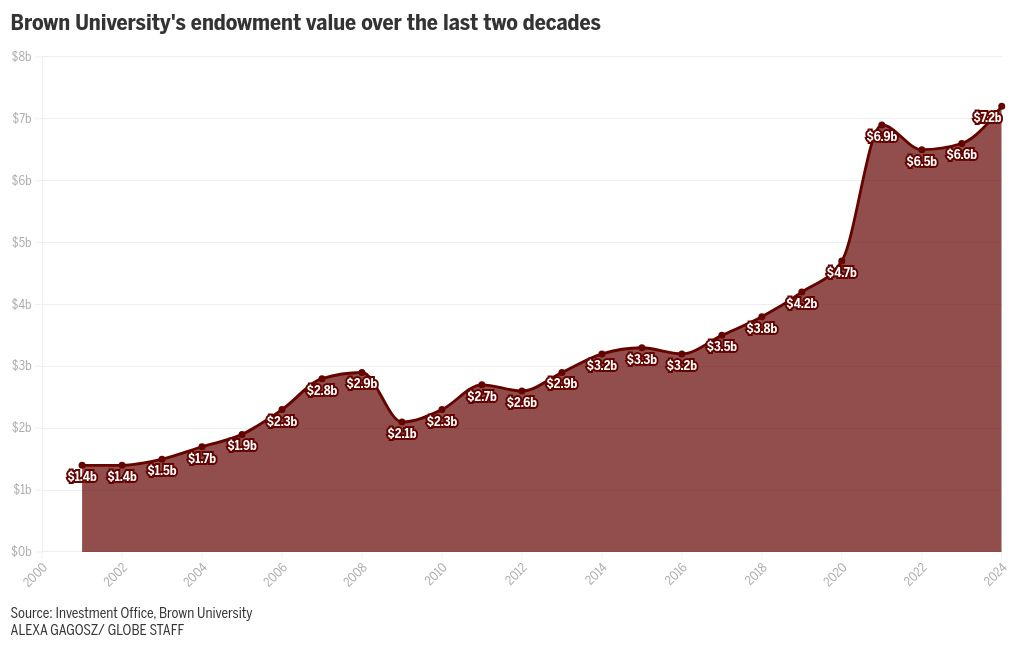
Call it what it is. Creative destruction. The machine already took the knowledge monopoly. The credential is next. Brown, and the whole tier of higher education built to sell it. All past their sell-by date. Maybe. The old order never posts its own expiry. It just stops being worth the price.
But the school is the smaller loss. The chart could not measure what the students did to themselves. They optimized for the credential and skipped the one thing the machine cannot rent them. The judgment you earn only by doing it alone first. Always armed. Never capable.
Mr. Balmer was right, in perhaps the way he really meant, absurd desert and all. Serrano ran the experiment without meaning to. Armed, the class averaged 96. Disarmed, 48. In an age of infinite tools, the only edge left is what you can do disarmed. The one who can cross the desert on foot gets the most from the machine. The machine gives little to the one who cheats.
I still know how to interpolate log tables. But I never forgot his story about the desert.
What higher education institution is going to listen to kids that say “this course is useless”? The administrators will argue the kids lack the experience to make that call. In my experience the institution hard codifies the paths so much that they forget to look to reality. Sometimes that still makes sense - I know a lot of good engineers that graduated through my college, but I also know of many individuals that skated through classes to get the certification just to move into the real world & use none of their experience in education, because it added little value to their roles in business. The certification (generic college degree) is probably upheld a little to much by the real world as a signal for competency for too many roles, exacerbating the issue of these institutions believing they have something of great value the participants should seek to aquire regardless of method or cost.
Carter, I think you missed the big picture.
We have proof a professor gave a test in a required course and the students used the machine to get an answer in a class they were forced to take to get a degree. That doesn't tell us they will be cheaters for life or that they lack judgment. It tells us they didn't care about the class, and there's likely a good reason it didn't matter to them. By your own logic that was a rational call.
As to whether those kids are lazy or unethical, I would bet most of those students are using the machine every day to expand and amplify their own agency against the things that are important to them. You could surmise that if they were using the machine every day to amplify their own agency, they should have had enough good judgment to at least read and retain the machine's output. But by not reading it, they only emphasized how unimportant the test and the class were to them.
I agree Brown and the rest of higher education are doomed if they don't change the model. But the professor has an even bigger challenge. If he doesn't figure out how to survive in the world of AI, he becomes the dinosaur, while his students likely will flourish, because they hold agency that has never before existed.
The real gap, the one your chart exposed but your essay never name, there is likely a missing layer that needs to be filled between humans and the machine. That layer needs to focus on intent, persistent specification, and continuous improvement on the path to achievement.